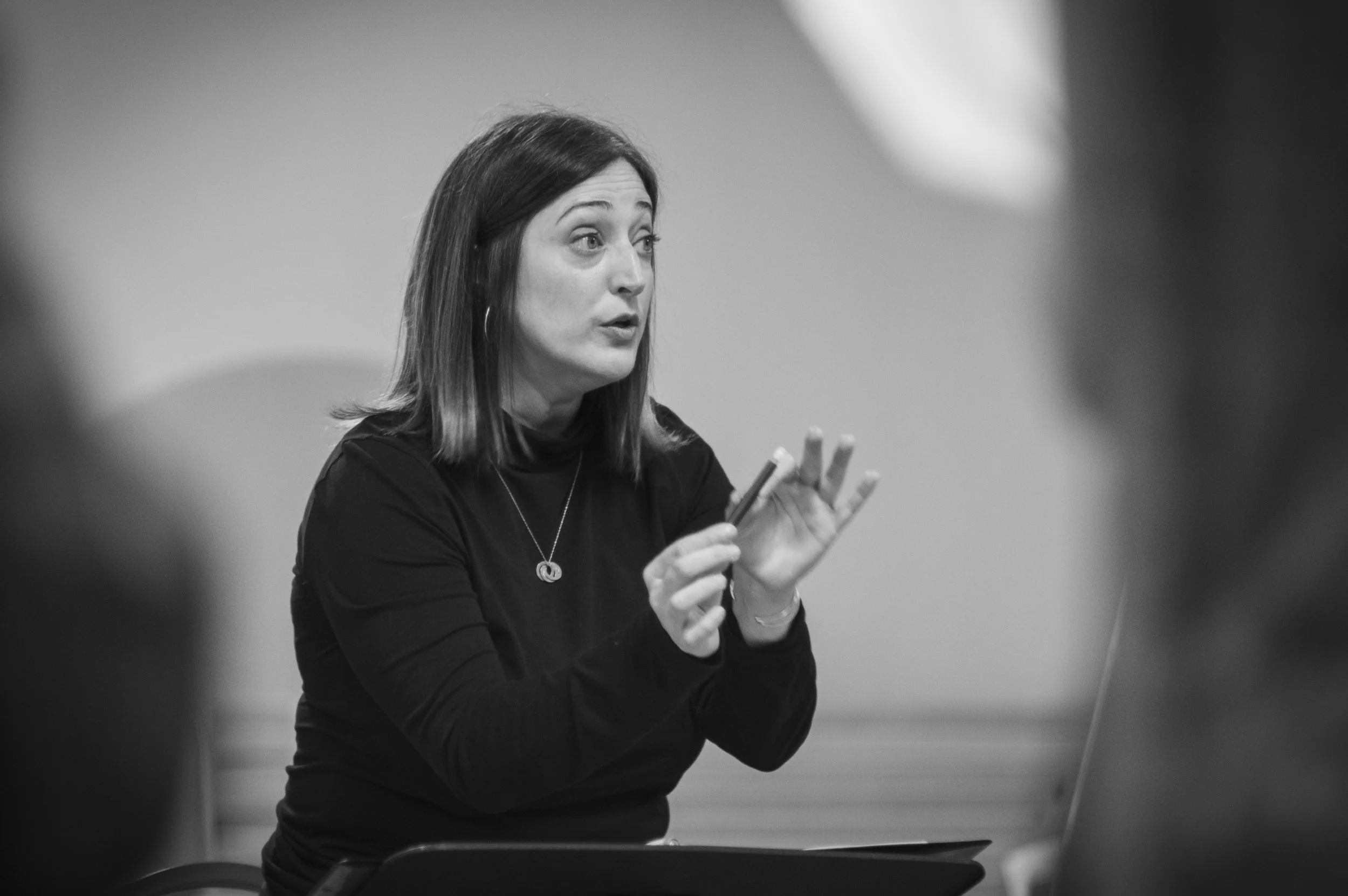
Hi, I’m Korrie.
I am a vocal coach, music director, and composer in San Diego, CA. I help musical theatre singers transform from “just another audition” into unforgettable storytellers who land callbacks. My coaching blends smart repertoire strategy, performance direction, and vocal guidance — so you walk into every audition confident, prepared, and fully yourself.
COMPOSER, LYRICIST & MUSIC DIRECTOR
Korrie Yamaoka is a composer and singer-songwriter based in San Diego, California, whose music blends elements of folk, indie rock, and jazz. With influences such as Ani DiFranco and Tori Amos, her music is known for its heartfelt lyrics, catchy melodies, and intricate piano work.
After spending many years as a music director in the San Diego area, Korrie is excited to return to her passion for writing and performing her own music. Her recent show, White Space, is a collection of songs that explore themes of love, loss, and personal growth, and showcases her unique blend of musical styles.
Explore her compositions, new creative projects, and upcoming events on her music page.
LEt’s Work Together
VOCAL COACHING & GROUP CLASSES
Looking for 1:1 Vocal Coaching that will help you deliver more authentic and nuanced performances? Seeking a community of aspiring artists with whom you can watch and learn together! Book a session to learn about private lessons and group classes to help elevate you as the artist.
Studying the Song
A PODCAST OF CONVERSATIONS FROM SOME OF THE BEST IN THE BIZ.
Hosted by Korrie Yomaoka, Studying the Song is a podcast dedicated helping artists with audition and music prep for musical theatre. Below are the most recent episodes. Go on, take a listen.
Recent Episodes
Have you ever wondered how much movement is too much movement in an audition?
Have you struggled to find movement that feels authentic to you?
In this episode, Roger Ellis (@rogerellis), head of movement in the MFA Acting Program at Northwestern University, shares how he develops character, creates choreography, and develops a directorial vision through the lens of movement.
He pulls back the curtain on his creative process and reveals the specific tactics he uses to devise choreography, dig deeper into a show’s themes, and how to bring out each actor’s truest self.
Roger Ellis (they/he) is a movement director and filmmaker investigating the mixed reality of Black-queer-aspec experience. Roger is the original director of Nikki Lynette’s Get Out Alive (Steppenwolf, film adaptation, National Alliance for Musical Theatre). Current projects include the documusical series Unhappy Songs About Unhappy Things, sound installation Interstitial and the short film Emergency Contact. Ellis is an assistant professor and head of the movement area for the MFA Acting Program at Northwestern University.
In this interview, we discuss:
(Click below to see full post and to listen to the episode!)
Ever wonder what it’s really like to WORK a National Tour of a Broadway musical? I mean, like being in BUSINESS as an actor and dealing with contracts, agents, and managers?
In this episode, April (@apriljosephine) shares her journey as an actor in New York and how she booked the First National Tour of Mean Girls. She admits that she had to learn the ropes of the business side of things by asking other actors while on tour. She also had to get active on the Equity website and find things out for herself.
In this interview, she tells you all the things she wish someone had told her, including:
The benefits of self tapes for actors with learning disabilities
What to look for in an agent
How and when do you pay your agent and manager
The audition and callback process for the First National Tour of Mean Girls
(Click below to see full post and to listen to the episode!)
A disarmingly honest conversation about career, loving yourself (ie your voice), and taking on the identity of "artist."
In this episode, you’ll hear Sasha talk about finding success in unexpected opportunities like workshops, readings, and cabaret shows. She also shares her honest realizations about fighting her “type” and coming to terms with her voice (which she now loves, btw).
Discover how training your brain and neurological system can instantly yield more freedom, control, and flexibility in your voice.
You guys, I’ve seen Kimberly Moller’s work first hand, and I have to say - it’s like magic!
In this episode, I ask Kim all my questions about how neurology (all things nerves and nervous system) affects our voice. How can we improve tone, resonance, and control so that we feel more freedom and ease as we sing?
(Click below to see full post and to listen to the episode!)
In this 2-part series, I’m going to tell you exactly how to mark your sheet music so that the accompanist has all the information they need to play well and in sync with YOUR version of the song.
Today’s episode covers
how to mark the cuts inside your song
whether to use highlighters
what to do if you’re changing lyrics
how to clearly mark your ending
and even a short tangent on Bruce Willis (So there’s that.)
(Click below to see full post and to listen to the episode!)
Learn the 6 pieces of information that MUST be on the first page of your audition cut.
Do you worry the accompanist won’t play your song the right way?
Well, worry no longer, friend.
In this 2-part series, I’m going to tell you exactly how to mark your sheet music so that the accompanist has all the information they need to play well and in sync with YOUR version of the song.
Today’s episode is a detailed run-down of what needs to go on the first page of your audition cut.
For most of us, we’re starting our song somewhere in the middle of the song, right? Well, there’s a ton of information that the accompanist needs to know that is ONLY ON THE FIRST PAGE of the music.
So, you need to transfer this information to the page you’re starting on.
I’ll also cover best practices surrounding binder choice and the age-old question: to use sheet protectors or not?
(Click below to see full post and listen to the episode!)
Let’s talk about 3 ways you can create contrast in your song choices and show your range of abilities and skills!
So you’ve got an audition coming up and they want you to bring “two contrasting songs.” What do you choose?
Do you find yourself paralyzed by this question?
Or at a minimum, staring at your audition book with a dazed and confused look as you struggle to decide which two songs to sing?
Well, let me help you out!
(Click below to see full post and listen to the episode!)
Ever wonder what you should be writing into your sheet music during rehearsal?
When I’m music directing a show, I have a very specific list of things I want singers to write down in their score. These are stylistic choices that go beyond what’s written on the page, and when everyone performs them as a unified ensemble, the music elevates to another level of nuance and professionalism.
But, what exactly are these “things” I’m telling them to write down?
Friend, let me tell you!
Today, I’m sharing nine essential music markings you should be writing in your score during every rehearsal!
Some of these markings are basic and others involve higher level musical analysis. But, ALL of them are integral to helping you:
Learn a song with precision and accuracy
Perform musical phrases with consistent interpretation choices
Sing in tune with other singers
Elevate your ensemble singing skills
And improve how you communicate with your music director and accompanists
(Click below to see full post and listen to the episode!)
You guys, this episode is GOLD!!!
I sat down with Jacole Kitchen, Casting Director for the La Jolla Playhouse (San Diego, CA), and asked her all the questions I’ve been dying to know about the casting process and what directors and casting directors are looking for in auditions. And, boy did she deliver!
We talked about:
What is the role of a casting director?
What place does “type” have in today’s climate of color-bold casting, reimagining roles, and creating equity for actors of all backgrounds?
What makes an actor stand out in the audition room?
What is expected in a self-tape?
And so much more!
(Click below to see full post and listen to the episode!)
Hey friends, in today’s episode we are talking repertoire suggestions from the rarely done (yet Pulitzer prize winning) musical, Fiorello! (1959).
From the writing team of Jerry Bock and Sheldon Harnick (also Fiddler on the Roof and She Loves Me), this Golden Age show has a score that alternates between brassy, energetic uptempo numbers and string-driven bittersweet ballads. Throughout all the songs, there is wit, humor, and emotional depth, and totally relatable POLITICAL COMMENTARY!
I’ll share the specific songs that you can pull out for audition material and cabaret shows as well as the ensemble numbers you can use with your college and high school students.
I hope this helps you find some Golden Age material that feels fresh and not overdone!
(Click below to see full post and listen to the episode!)
Follow me, Friend!
@ Korrieyamaoka